The Environment’s Hide and Seek Champions
The Environment’s Hide and Seek Champions
Finding what was once lost – Why does it matter?
By Dr Darren Pietersen, project Manager, and Dr Samantha Theron, conservation researcher

Left: Blyde River Flat Geckos (Afroedura rondavelica)
In a world that is increasingly, and sometimes irreparably, being impacted by human development, it is inevitable that we will lose species forever through extinction. But, luckily, some species are lost for other reasons and can, in a manner of speaking, be ‘brought back from the dead’. These are termed ‘Lost species’.
What are ‘Lost species’?
Re:wild and the International Union for the Conservation of Nature Species Survival Commission (IUCN SSC) designate a species as being lost for a number of reasons. These are:
- if it has not been scientifically documented in at least 10 years – there have been no formal reports of this species in at least a decade ),
- it is not formally listed as Extinct on the IUCN Red List of Threatened SpeciesTM (the global barometer of how life on Earth is faring, and which guides conservation efforts), and
- there is no captive population being held in any zoological garden or similar ex-situ
Lost species often share characteristics such as being secretive. occurring at low densities and being found in areas that are difficult to access. Additionally, these species are difficult to detect, or are only known from a type specimen or a handful of specimens. The type specimen is the specimen that the species’ name is attached to, and which is often the first specimen that was collected of that species. or a handful of specimens.
Why do we look for lost species?
For one, the quest to rediscover a lost species often takes the searchers into areas that few other scientists have visited, This sometimes leads to additional discoveries of species that are new to science.
These species also sometimes inhabit areas of such high biodiversity and endemism that these areas warrant formal recognition and protection, and the ancillary species diversity and distribution data that are gathered during the search for a lost species helps support this decision-making process. But, more importantly, finding lost species sheds light on the conservation status of these species, allowing us to assign them to the most appropriate threat category on the IUCN Red List. This in turn guides what conservation measures are required to protect the species, and what resources, if any, should be dedicated to these species’ conservation.
Under the Kunming-Montreal Global Biodiversity Framework (KMGBF), signatories are required to halt the loss of biodiversity by 2030, and rediscovering ‘Lost’ species directly supports this ambitious goal. Sometimes a species is considered lost simply because it occurs in an inaccessible area where the population is actually thriving and not in need of immediate conservation attention. In such cases, limited conservation resources can rather be diverted to another species that is in greater need of immediate protection.
In other instances, lost species have are deemed absent as a result of changes in land use or other anthropogenic activities. In these instances, the species are often in urgent need of targeted conservation action, sometimes to the extreme where a captive population needs to be established to conserve the species until suitable habitat is either secured or restored, and the animals or plants can be returned to the wild.
How does one go about finding a ‘Lost’ species?
Re:wild hosts a list of currently recognised lost species on their website. Therefore, rediscovering thse species involves first identifying which one you are setting out to find. This is followed by extensive research, learning all there is to know about your species of interest, as well as any closely related species. It provides the necessary background information on where and when the best time would be to search for the species, and the best survey techniques to employ to maximise your chances of finding your quarry. Sometimes the best approach to rediscover a lost species is good old-fashioned leg-work – spending hours, days or even weeks, scouring suitable habitat in search of a particular species.
Sometimes you are rewarded, as was the case of the Blue-tailed Sandveld Lizard (Nucras caesicaudata) where we documented not one, but three records of this highly elusive species in the past year – with the only other record since this species’ formal description in 1972 being a site record in 2002.

Left: the Blue-tailed Sandveld Lizard (Nucras caesicaudata)
At other times all that is required is visiting an inaccessible site. An example was the expedition we undertook in early 2025 that led to the discovery of a thriving population of Blyde River Flat Geckos (Afroedura rondavelica) – a species which up until then was only known from two specimens collected in 1991.
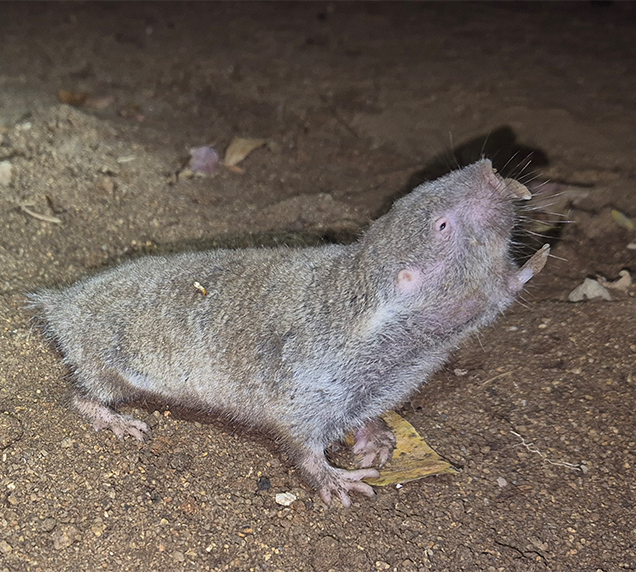
Other species are far more cryptic and require a more targeted approach. This was the case with the rediscovery of de Winton’s Golden Mole (Cryptochloris wintoni) which had been lost for 87 years. In this instance, scent-detection dogs and targeted Environmental DNA (eDNA) sampling led to the rediscovery of this cryptic, secretive species.
eDNA sampling is a technique whereby environmental samples (usually soil or water samples) are collected and genetically analysed to infer what species are present in an area through sequencing the DNA fragments that all lifeforms shed as they navigate their environment. Using DNA sequences from closely related species, our eDNA specialist, Dr Samantha Theron, was able to generate genetic primers that would specifically amplify golden mole DNA, a step which ultimately led to the rediscovery of this species.
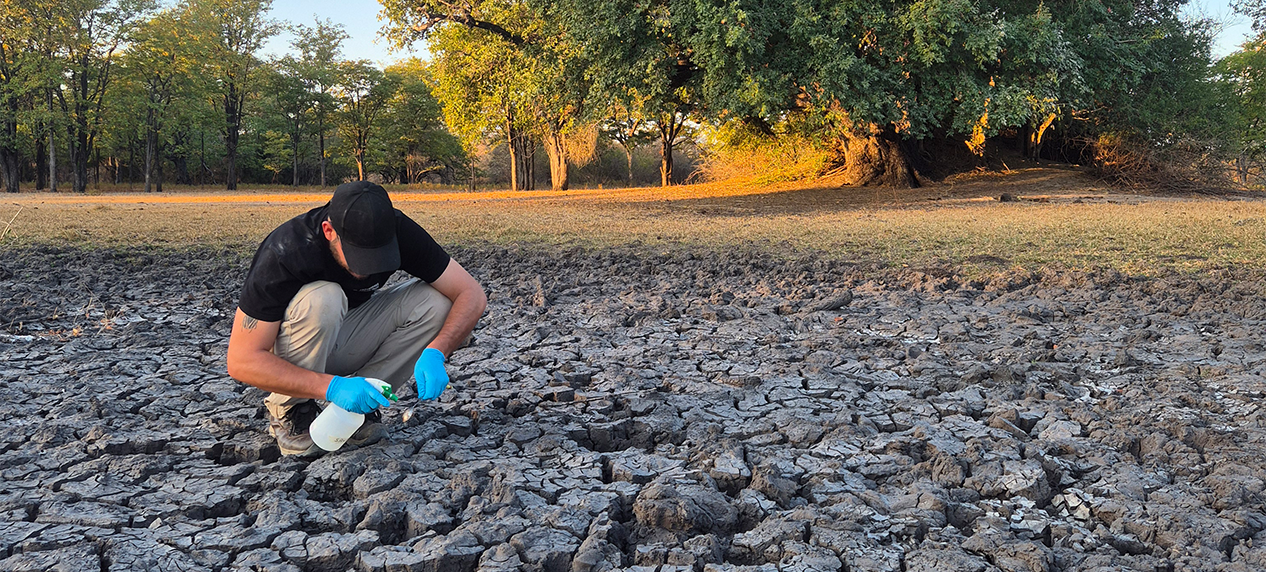
During the project to rediscover the De Winton’s Golden Mole, soil samples were collected from the moles’ underground foraging tunnels. The eDNA extracted from these samples enabled genetic verification of the species, helping the surveillance team to determine where to focus their search. Our scent detection dog, Jessie, who had been trained specifically to sniff out golden moles, assisted the team in locating these tunnels. We eventually trapped a live mole to obtain a genetic sample for species verification.
Environmental DNA sampling has been gaining traction globally as a biodiversity surveillance and monitoring approach, and has also been used to find other lost species across the globe. Surveys in the Atlantic Coastal Forest and Cerrado grasslands used eDNA to confirm the presence of the Bocaina Giant Frog, Megaelosia bocainensis, which had not been seen in decades. Researchers have applied eDNA surveys around Lake Tota in Columbia to search for the elusive Fat Catfish that had been lost since 1957. In Wales, eDNA was used to screen waterways for the Yellow Sally Stonefly (Isogenus nubecula), which was assumed locally extinct across major Welsh river systems for many years.
Although eDNA is revolutionising conservation science in many ways, it is not without limitations. One of the challenges of eDNA-based surveys is the availability of reference DNA barcode sequences in online repositories, as species identification depends on these. This may pose a particular challenge in the search for lost species, many of which may not have any reference DNA sequences available at all. However, in these cases it is always possible to determine the origin of the eDNA down to a certain taxonomic level, such as family or genus, which may provide sufficient insight when surveying large areas and using eDNA to determine where to focus more targeted surveys.
eDNA is one of many innovative approaches used to search for elusive species, and when combined with approaches, such as camera trapping, drones, acoustic surveillance or scent-detection, doors that had been shut for decades can be opened to the rediscover species.
So what does the future hold?
There is no shortage of lost species to search for, with Re:wild listing more than 4,300 ‘lost species’ across 200 countries.
The EWT, through our Biodiversity Surveys or Bioblitz Program and other targeted initiatives, will continue to search for lost and new species throughout southern and East Africa, gathering valuable data on the distribution and taxonomy of other species in the process.
These data will help inform conservation initiatives and guide the application of resources, alongside our continuous engagement with relevant governments and stakeholders to ensure targeted and timely conservation of (re)discovered species, while simultaneously trying to prevent additional species from being entered onto the ‘Lost species’ list.