People behind the paw: Clive Walker
People behind the paw: Clive Walker
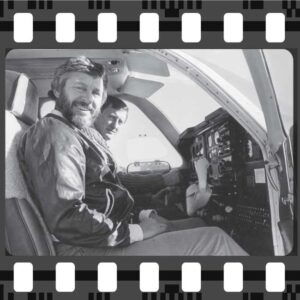
Clive Walker in a helicopter
Clive Walker, Founder
My wildlife journey commenced as a teenager with my mother and aunt Peggy taking my brother Barrie, three cousins, and myself to the Johannesburg Zoo more than 76 years ago. My cousin Elizabeth and I were old enough to ride on the back of an Indian (Asian) Elephant. The zoo later stopped offering elephant rides, but I never got over the experience of riding on one of these amazing animals.
A few years later, after my mother purchased a 1948 Chevrolet 4-door sedan, I saw elephants and baobab trees in the Kruger National Park, both of which fascinated me and filled me with awe. My mother, grandmother, and aunt Francis, who was an ambulance driver in the Western Desert during World War II, accompanied us to the Kruger every winter for a week, camping in cottage tents with iron beds, water pitchers, iron chairs with wooden slats, and bathrooms we would have to find with a paraffin lantern in the evenings. The start of a long African safari.
Elephants and rhinos have occupied much of my time throughout my life. In the case of elephants, I have ridden them, painted them (simply awful), witnessed them being hunted and culled, tracked them on foot as a ranger and a guide, fled from many, researched them, counted them, photographed them and in time painted better pictures of them, and devoted much energy to conserving them. My original journey into the realm of elephants commenced in the mid-1950s at the age of 21 when I accompanied my mentor and old enough to be my father, Hans Bufe, a South African of German descent on a safari into Portuguese East Africa (Mozambique) to hunt elephants. Yes, you read correctly. Over the next three years, I focused mainly on hunting and collecting – not only trophies but ‘knowledge’ gained from our Shangaan trackers, who knew even more than Uncle Hans. This knowledge proved invaluable when I was a ranger in Bechuanaland and later a ‘wilderness’ guide in elephant and lion country. The conservation world of today is not the world I grew up in, although most of my friends and my mother thought I was insane at the time and that I stood a good chance of being killed which bothered them more than my desire to shoot an elephant. Today’s world is very aware of the decline in the continent’s elephants and wildlife in general. The irony is that today we have far more elephants across Southern Africa than we ever had in the 1950s. In fact, by the turn of the 19th century, very few elephants survived outside of the Kruger National Park, which had few elephants to speak of.
When I stood in the great hall of the Natural History Museum in London one summer day in 1959 and gazed upon a fully mounted family group of elephants, a strange feeling of remorse came over me. What possessed me to think I wanted to kill one of these animals? I never again felt the urge to do so. The walking trails among elephants I led over the 20-odd years that followed were successful largely due to the knowledge I gained from my Shangaan trackers in Portuguese East Africa. I never once got into a situation where I had to kill an elephant or any other dangerous game in self-defence.
From London, I returned to Africa down the East Coast in January 1960 and realised a long-held desire to visit Kenya and, in particular, to view Mount Kilimanjaro, which I and four other shipboard companions did while staying in the Tsavo National Park. Around a million elephants still existed in Africa, and perhaps 100,000 rhinos. Twenty years later, I returned to the same park as the Director of the EWT, and it was an entirely different story I was to encounter. The park once held some 9,000 black rhinos, and all had died from drought and heavy poaching. They had become extinct, and I was devastated.
My conservation journey commenced as it did from my first ever five-day walking trail in the iMfolozi wilderness in 1972, which was to lead to a total change in my life’ s direction and led to the founding of the Endangered Wildlife Trust in 1973.