Help protect Africa's 

Careers in Conservation – Eugene Greyling

Careers in Conservation – Eugene Greyling

CAREERS IN CONSERVATION – Eugene Greyling

Eugene is a Field Officer with the EWT’s Carnivore Conservation Programme. Here is a little bit about Eugene’s journey to a career in conservation with the EWT.

Job Title: Carnivore Conservation Field Officer

What do you do in your day-day work? No day is quite the same. I am primarily assigned to the Range Expansion Project. My responsibilities vary between looking after predators in the EWT Holding Facility/Boma, community consultation and relations, assisting and advising with relocations, post-release monitoring of translocated predators, partner engagement, and a wide variety of other interesting tasks.     

Location: Welgevonden Game Reserve, Waterberg, Limpopo

Where did you grow up? I have been privileged enough to experience best of both worlds – I was raised in the farming community of Oudtshoorn in the Western Cape but moved to Dubai in the United Arab Emirates during my early high school years. 

What are your hobbies/things you like to do in your spare time? I volunteer as a wildland fire practitioner and enjoy working with snakes. I also never say no to a good road trip or hike, and travel as often as possible.

Any pets? I wish, if only I was allowed to have any. That’ s the trade-off to living on a nature reserve I suppose.

Favourite animal and why:  I’ ve spent the last couple of years working on leopards, so I think it is fair to say that I have developed a soft spot for them. However, I think this might be a slightly unfair question to ask any wildlife ecologist. 😃

Favourite food? There are very few things that can compete with a good butter chicken in my opinion. Of course, there is always a proper braai as well.

Pet peeve?  When people throw rubbish out of their car window, or anywhere else for that matter, with the expectation that someone else will clean up after them. Also, weak coffee.

Why did you want to work for the EWT? As a well-established organisation that sets the standard in innovation, research, and well-informed applied conservation across Southern Africa, I believe there is no better environment than the EWT to learn from, develop within, and contribute to as an early-career wildlife ecologist. With a holistic, integrated strategy that recognises not only species, but also landscapes and the people that share in those landscapes, the approach of the EWT is something I deeply resonate with. Ultimately, I believe that the EWT provides the ideal platform to be able to remain curious and to make a real collaborative difference, and that is what I am here for.

What are you passionate about?  I am convinced that every person has the ability within to influence those around them, be that by means of real, honest conversation or by virtue of exemplary actions. Often, I find myself standing in awe of the long-term impact that individual change can have on a community, and in turn on the natural environment. Therefore, I enjoy seeing people grow and develop and being part of that process, even though my first love has always been Mother Nature. During the past few years of studies and time spent volunteering with several conservation organisations, I came to realise that the biggest long-term influence we can have is by targeted education in communities where we can plant a seed that will drive local change from within – tackling problems using solutions crafted together that empower and benefit stakeholders for the greater good of the ecosystem. After all, conservation is about people. In order to ensure that we make a positive impact as conservationists, be that by means of education or effective adaptive management of landscapes that facilitate biological diversity, we need to be sure that the change we instil is accurately informed. Thus, I find myself in the realm of ecological research, with a particular passion for animal behaviour and socio-ecological dynamics, including human-wildlife coexistence and spatial ecology.

What’ s the best advice you’ ve ever received, and who did it come from? “Listen with the intent to understand, not to respond” – I believe it is a quote by Stephen Covey, but my granddad was the one to share this wisdom with me.

What is your go-to feel-good song? Bubble Toes by Jack Johnson

What excites you about this new position? Every day out in the field brings new and exciting challenges – it never becomes monotonous. Having the privilege to be able to learn from a great group of experienced colleagues, as well as the opportunity to travel as part of my work, is also very exciting.
Science Snippets: Wild Dogs steer clear of lion scat

Science Snippets: Wild Dogs steer clear of lion scat

Science Snippets: Wild Dogs steer clear of lion scat

Erin Adams and Lizanne Roxburgh, the EWT Conservation Planning and Science Unit

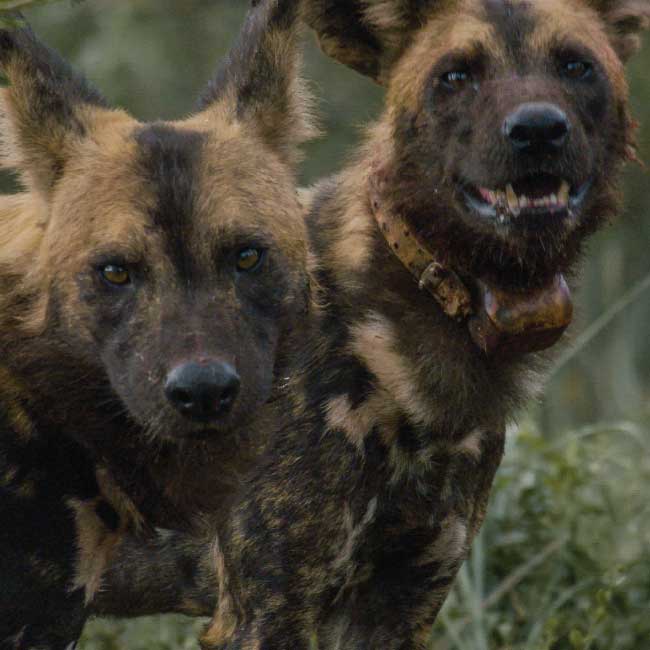
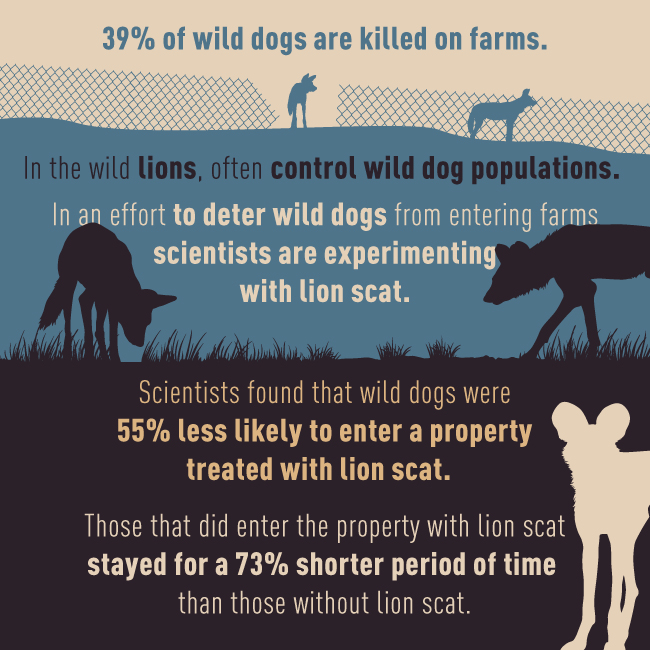
African Wild Dogs (Lycaon pictus) are currently classified as “Endangered” on the IUCN Red List. Within South Africa, there is a free-roaming population, which is a population of Wild Dogs that occur outside of protected areas. This population makes up as much as 20% of South Africa’ s population. As they are not within protected areas, natural prey for Wild Dogs is often limited. Therefore, the Wild Dogs may move through private farming lands and consume the livestock and game, which brings them into conflict with the landowners. An estimated 39% of free-roaming Wild Dogs are killed through direct persecution resulting from this conflict. A recent study* co-authored by EWT scientists has tested a novel way of keeping Wild Dogs off private land and safe from persecution.

In their natural environment, dominant predators, such as lions, often control Wild Dog populations. Therefore, scientists aimed to keep Wild Dogs out of certain areas by using the scat of lions as a proxy for lion presence. As some of the Wild Dogs were already fitted with GPS trackers, it was easy to monitor their movements. The scientists tested whether the lion scats alone could deter Wild Dogs from entering private property and causing a threat to livelihoods. Within the study, some properties were treated with lion scat, while others were not treated with lion scat as a control to test the effectiveness of lion scat as a deterrent.

infographic on Wild Dogs

A recent study* co-authored by EWT scientists has tested a novel way of keeping Wild Dogs off private land and safe from persecution.

The scientists found that Wild Dogs were 55% less likely to enter a property treated with lion scat. Those that did enter the property with lion scat stayed for a 73% shorter period than those without lion scat. The scientists also found that some Wild Dog packs were more sensitive to the presence of lions than other packs were, likely due to the packs’ different exposure to and interaction with lions.

The results of the novel approach to managing free-roaming Wild Dogs tested in this study may benefit Wild Dog conservation by reducing conflict with farmers and other landowners. Further studies on using biological cues to control large carnivore movements should be conducted as this could play a significant role in their conservation.

*Haring, R. D., Beverley, G., Thompson, P. N., Taylor, A., & O’ Dell, J. H. (2023). Evaluation of lion (Panthera leo) scat as a Wild Dog (Lycaon pictus) deterrent on game farms. Wildlife Research. https://doi.org/10.1071/WR22084.

Science Snippets: Not all carnivores are monitored equally

Science Snippets: Not all carnivores are monitored equally

Science snippets: Not all carnivores are monitored equally

Erin Adams and Lizanne Roxburgh, the EWT Conservation Planning and Science Unit

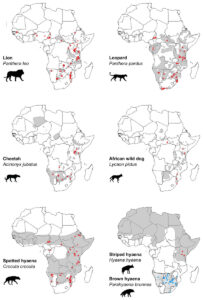
The locations of peer-reviewed African large carnivore studies (2000–2020) from Strampelli et al. (2022). Red crosses show where research has taken place, except in the case of Brown Hyaena, where blue crosses are used. Grey areas represent current geographical ranges, except in the case of Brown Hyaena, where a dotted pattern is used.

African large carnivores have undergone significant population declines over the years. Important information needed to conserve them is how many individuals are left in the wild, which can be gained through monitoring, but not all carnivores have been monitored equally. In a recent publication* co-authored by EWT scientists, the monitoring programmes of African carnivores were reviewed to identify important knowledge gaps. 

The scientists assessed all scientific publications on the African Lion, leopard, Cheetah, African Wild Dog, Spotted Hyaena, Striped Hyaena, And Brown Hyaena produced since 2000. From there, they could assess which species were extensively monitored and where the research was lacking. The scientists also considered the species’ ranges across Africa and whether all regions carnivores occurred in were monitored equally.

The scientists found that the African Lion was the most researched species, followed by the Striped Hyaena. However, of the study species, the Striped Hyaena has the largest distribution across Africa but has not been studied equally across its distribution (see the figure below). The African Wild Dog had very little research attention across its narrow range. Scientists also found that the larger the distribution of a specific species within a country, the more research was done on that species. Countries such as South Africa and Kenya were among the best studied, while countries in Africa’s Northern, Western and Central regions were generally understudied.

The study further revealed that, outside of South Africa, more than 40% of the studies did not include authors from the study country. Therefore, there is a need to upskill and build capacity within African countries to better protect African carnivores across their range.

*Strampelli, P., Campbell, L. A., Henschel, P., Nicholson, S. K., Macdonald, D. W., & Dickman, A. J. (2022). Trends and biases in African large carnivore population assessments: identifying priorities and opportunities from a systematic review of two decades of research. PeerJ, 10, e14354.

Science Snippets: Why did the Wild Dog cross the fence?

Science Snippets: Why did the Wild Dog cross the fence?

SCIENCE SNIPPETS: WHY DID THE WILD DOG CROSS THE FENCE?

ERIN ADAMS AND LIZANNE ROXBURGH, THE EWT’ S CONSERVATION PLANNING AND SCIENCE UNIT

Within South Africa, fences are used to contain wildlife in reserves to protect them, particularly in human-dominated landscapes where they could easily come into conflict with people if they leave the reserve. This is especially true for medium to large-sized carnivores. However, they do cross these fences, and once outside, they are exposed to risks such as snaring, persecution, and collisions with vehicles, and any livestock they kill can incur high costs in the form of retaliatory killings by farmers. However, the reasons why they cross fences are not well understood.

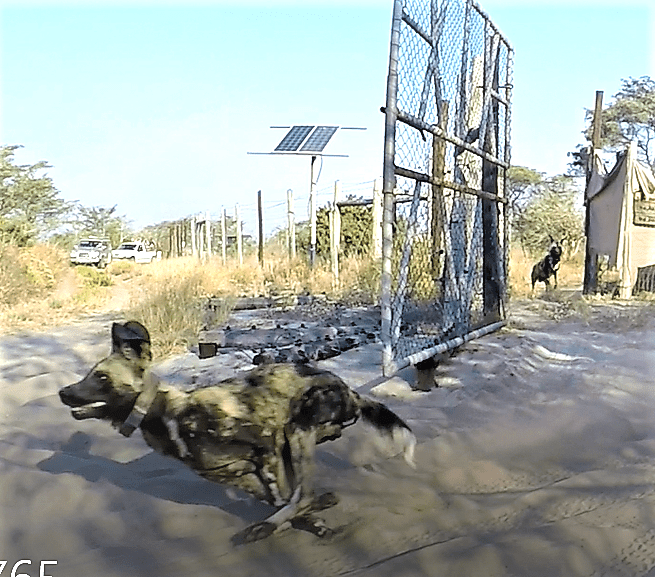
African Wild Dog conservation, especially in southern Africa, often includes the translocation of wild dogs from one or more reserves and the formation of a new pack in a different reserve to ensure that genetic diversity is maintained and that population sizes are appropriate. In a recent publication co-authored by EWT scientists*, the reason behind why African Wild Dog packs cross reserve fences was investigated. Using a long-term dataset, they studied 32 Wild Dog packs across five reserves in the KwaZulu-Natal province in South Africa over 14 years. During this time, they recorded 154 events when Wild Dogs crossed fences. They looked at several factors that could be linked to fence crossings, including prey densities, rainfall, wild dog pack size, and the number of lions in the reserve.

The scientists found that the age of the pack (i.e., whether it was newly formed or well-established) and the fence integrity affected whether or not Wild Dog packs crossed the reserve fence. When fence integrity was poor, the probability of packs crossing the fence was higher, especially with newly established packs. This happens in their exploratory phase when they look for territories to occupy in the new reserve. When fence integrity was average, more established wild dog packs were more likely to escape to increase the size of their territories. When fence integrity was good, the probability of packs crossing fences was very low. Reserve management should ensure that the fence’ s integrity is good to prevent these crossings. It is also important to carefully manage packs that reach about 3.5 years old, as this is when they would be more likely to expand their territories and attempt to cross the fence.

*Stone, D. W., Kelly, C., Marneweck, D. G., Druce, D. J., Hopcraft, J. G. C., & Marneweck, C. J. (2022). Fence management and time since pack formation influence African Wild Dog escapes from protected areas in South Africa. Journal for Nature Conservation, 70, 126291.

Looking for Lions

Looking for Lions

Looking for Lions

Marnus Roodbol, EWT Carnivore Conservation Programme, Lion Project Coordinator

There aren’ t many people who truly know how difficult it is to locate and sedate WILD Lions. The Endangered Wildlife Trust (EWT), SANParks, the National Administration of Conservation Areas in Mozambique, the Mozambique Wildlife Alliance, and Peace Parks Foundation are monitoring the distribution and movement of Lion prides across the Great Limpopo Transfrontier Conservation Area (GLTFCA) using GPS satellite collars. By monitoring prides over time, we can identify priority areas where Lions are likely to be at certain times, informing anti-poaching teams where to go to protect the Lions under their care. But to collar them, we need to find and sedate them. Not so hard, right? We are the most intelligent species, after all…

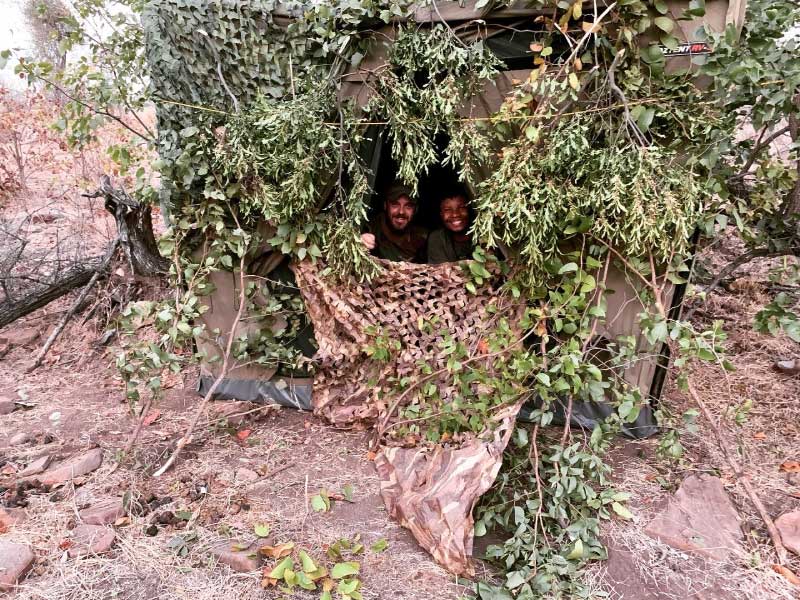
We’ve tried everything – including hiding and hoping the Lions wouldn’t know we were there so we could study them.

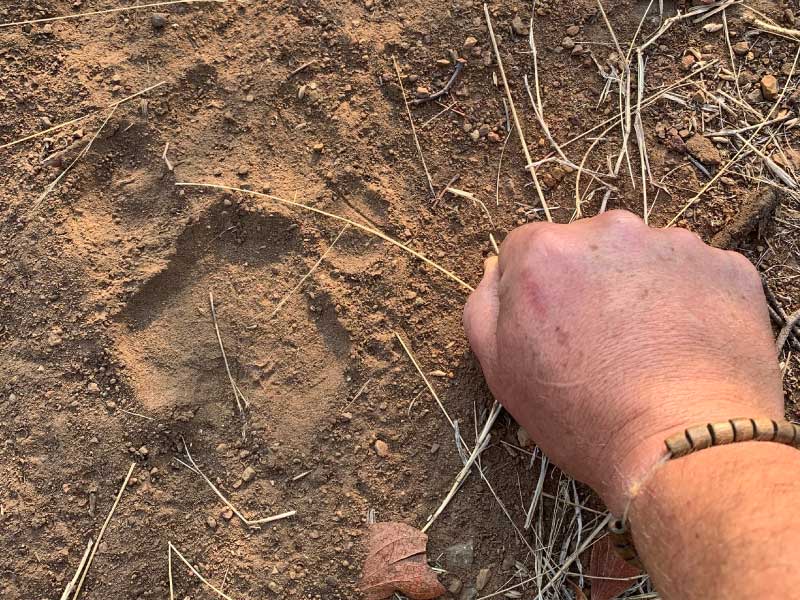
Alas, we have spent countless hours setting up the “perfect” trap, but these clever cats show us time after time just how intelligent they are. We searched on foot, by air, and yes – found a spoor here and there – but barely catch sight of them. My colleagues and I decided to set some bait for them, call them in using prey distress calls on a loudspeaker, and see if they were willing to participate in a feast.

We heard a Lion calling back softly, letting us know they were in the area, and we decided to head back to camp, shut off all the lights, and get an early one, so we could find them at the bait first thing. We did this so they wouldn’ t feel threatened by our presence and leave the area before the vet arrived the following day. Plus, they’ re always a little lazy after a meal, and we had set out a nice buffet for them.

I was woken up at 2 am by a roar near the camp. I was more excited than scared that this magnificent beast was so close by, not to mention relieved that they were indeed heading towards the bait…or so we assumed, not silly enough to leave the “safety” of my tent to check.

Early the next morning, we rose full of hope and energy and with a spring in our steps, knowing the Lions were close. We had no idea how close. We grabbed some hot coffee before sunrise and, at first light, decided to take a walk to the bait to see what transpired during the night. We took several steps, and then what had happened during the night hit us like a freight train.

These lions came to visit US before going to the bait. One got to within 3 m of my little tent, with two others approaching from the other side. We didn’ t hear their footsteps. We didn’ t smell them. We had no idea they were so close! With my knees a little shaky, I was truly humbled. But, it was an experience I will treasure forever – coming so close to the species I have dedicated my life to conserving.

How long will it take us to collar one? Find out in the next instalment of this epic tale.

Donate to save Lions here