Help protect Africa's 

South Africa’s National Crane Census 2026

South Africa’s National Crane Census 2026


547 people took part in South Africa’s

National Crane Census in July 2026


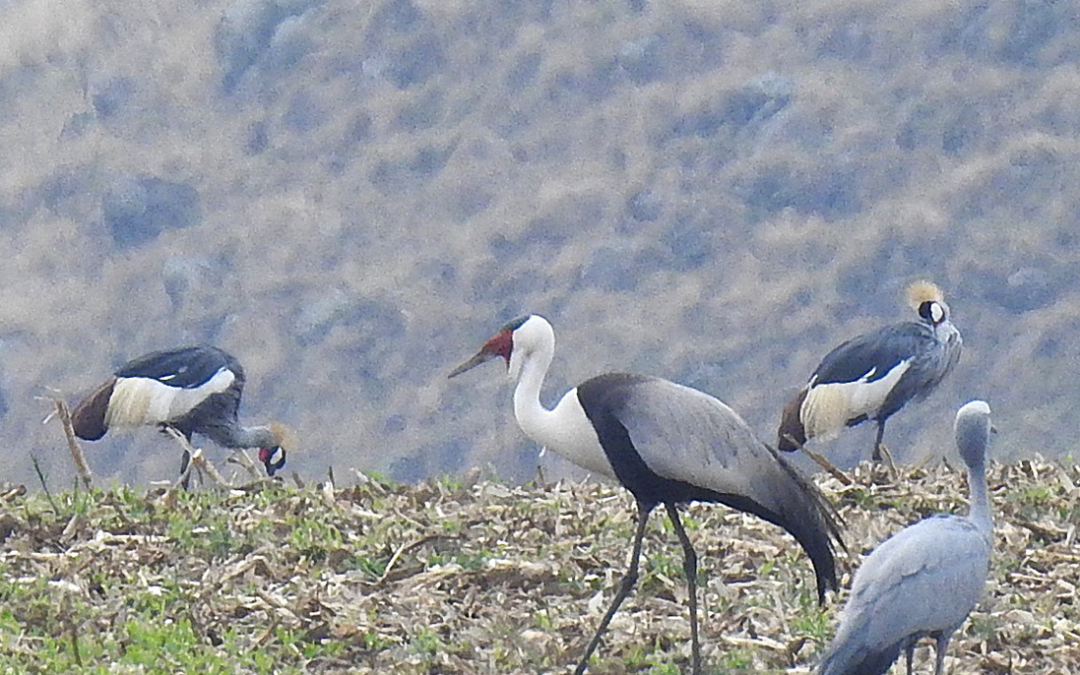
Left: Wattled Crane and Right: Grey Crowned Crane


A total of 547 South Africans took part in South’s Africa’s first National Crane Census in 20 years in July, reporting sightings of 18,888 Blue, Wattled and Grey Crowned Cranes on farmlands, in wetlands, open spaces and conservation areas across the country.

These sightings were recording during the Endangered Wildlife Trust / International Crane Foundation National Crane Census   in July 2026 under the banner of “Every Count Matters”.

The National Crane Census in South Africa relied on citizen science to provide vital information to estimate population size and to update distribution maps across the different species ranges.  Unlike in the past where participants had to complete forms that were only available in certain places, or posted, people were thus time able to make use of their cellphones to submit the number of cranes together with a location.  This made it easier for any member of the public to participate in the 2026 census.

South Africa’s crane species

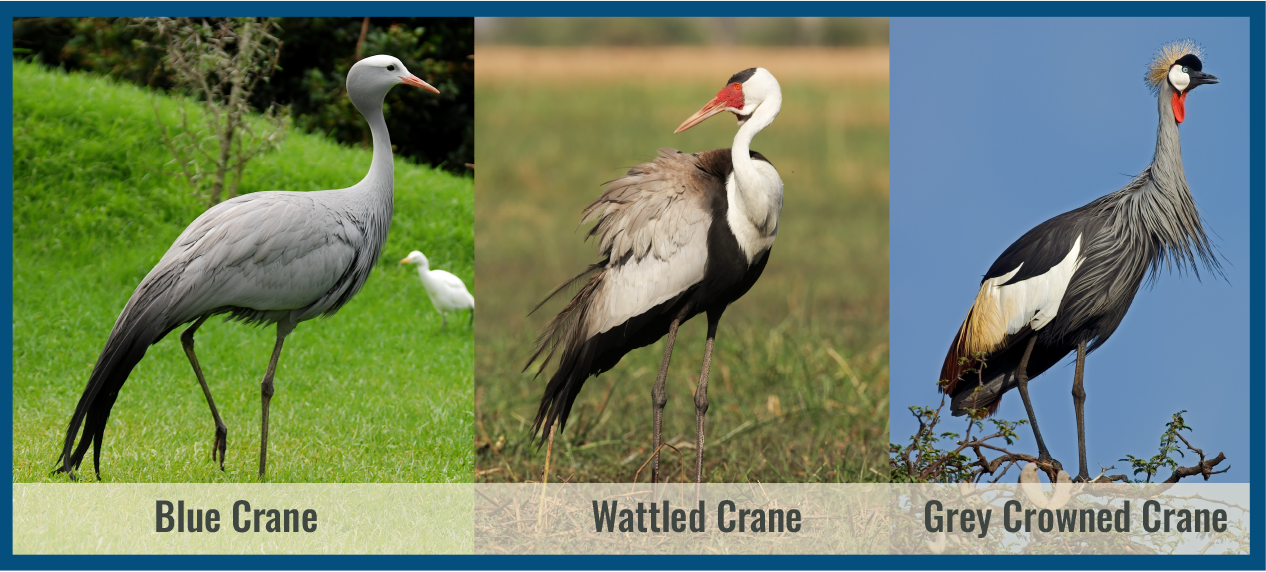
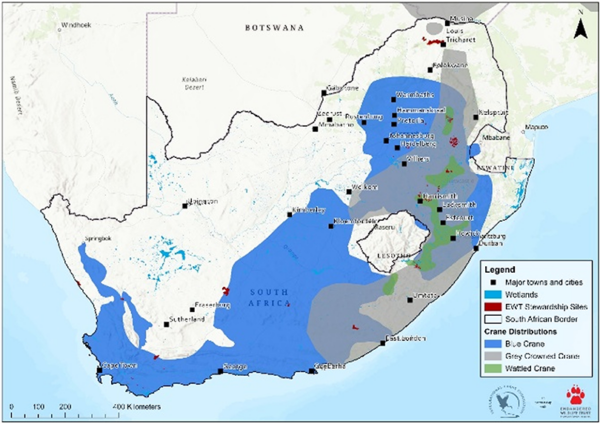
South Africa is home to three crane species – the Blue Crane, Wattled Crane and Grey Crowned Crane – with the Drakensberg range being a global hotspot for all three species. Since the last National Crane Census 20 years ago, the EWT/ICF partnership has been conducting localised aerial surveys that indicate that the populations of the three species are increasing in KwaZulu-Natal, but that all three species are declining in other areas. The Blue Crane, South Africa’s National Bird, was uplisted from Near Threatened to Vulnerable in the 2025 Red Data Book of Birds of South Africa, Lesotho and Eswatini reflecting growing concern about the species’ future. Concerted and targeted conservation efforts in the Drakensberg have seen the Wattled Crane downlisted from Critically Endangered to Endangered, while the Grey Crowned Crane is listed as Vulnerable in the SA Red Data Book.

Wattled Cranes are good indicators of the health of the environment, particularly wetlands and grasslands.  Cranes are among the world’s most culturally significant birds, including in South Africa. They are widely associated with longevity, wisdom, fidelity, peace, vigilance, and hope, making them powerful ambassadors for both natural and cultural heritage.  Considered a flagship species for conservation, the habitat for these majestic birds is being destroyed by mining, development and overuse.  This includes collisions with power lines and other infrastructure.


Left: Wattled Crane and Right: Blue Crowned Crane


What did Citizen Scientists see?

The largest flock of more than 500 Blue Cranes was spotted on a harvested pivot field near Groot Brak Rivier in the Western Cape, while a flock of more than 150 Grey Crowned Cranes was recorded at Himeville in KwaZulu-Natal.

In KwaZulu-Natal, Mpumalanga, Free-State and Eastern Cape where more than one species of crane occur, 22 people were lucky enough to see all three South African crane species during the census. Ninety-six people saw two crane species, mainly Grey Crowned Cranes and Blue Cranes.

One person was lucky enough to see the hybrid Blue Crane-Wattled Crane juvenile, which was incredibly useful information as we did not know where the juvenile had gone since being colour-ringed. It was sighted 200km from the site where it was raised by mixed species parents – a Blue Crane and a Wattled Crane.

In addition, three colour-ringed cranes were recorded during the census – one in Mpumalanga, one in KwaZulu-Natal and one in the Free State. This information is important for us to understand the movement of cranes, which is possible by comparing the areas where the colour rings were first placed on the cranes and where they were located during the census. The EWT has been placing colour rings on the legs of some cranes over the years, but it has been challenging to sight them again due to the distances that cranes can move after ringing has taken place.

The census has got South Africa talking about and caring about cranes. This is important to the conservation of species that occur almost entirely on privately owned land. The data itself has given us information about where cranes occur.  collected has provided us with valuable data to guide future conservation actions and management decisions for the benefit of cranes. This was especially useful for the rare Wattled Crane, where the sightings submitted have shown us new areas where Wattled Cranes occur, helping us direct conservation attention to this Endangered species.

The results

There was a total of 970 sightings submitted to the EWT/ICF census, 300 of which were sent before and after the four-day census period of 24 to 27 July.  We were able to map 824 sightings that were accompanied by coordinates. Unfortunately, some of the records had to be removed, if the species or location information was missing or incorrect.

In the final dataset, Blue Crane sightings numbered 13,172, Grey Crowned Cranes 4,944 and Wattled Cranes 384.  Although South Africa counted a total of 18,888 cranes across the country, 388 cranes had to be left out as their species was not specified. The majority of cranes were counted in KwaZulu-Natal with5,913 cranes, followed by the Eastern Cape with 4,161 and the Western Cape with 3,441.

Records by Province:

Province Blue Crane Grey Crowned Crane Wattled Crane
Eastern Cape 3,399 743 6
Free State 1,362 251 9
KwaZulu-Natal 2,345 3,321 245
Mpumalanga 440 109 6
North West 2    
Northern Cape 287    
Western Cape 3,322    

Archives

EVERY COUNT MATTERS: South African Crane Census

EVERY COUNT MATTERS: South African Crane Census

EVERY COUNT MATTERS: South African Crane Census

By Lara Fuller, Drakensberg Project manager, African Crane Conservation Programme


Endangered Wildlife Trust crane conservation fieldwork

The Endangered Wildlife Trust (EWT) and International Crane Foundation (ICF) partnership has been working on crane conservation alongside key partners such as Ezemvelo KwaZulu-Natal Wildlife, the KwaZulu-Natal Crane Foundation, and Eskom for the past 30 years. These collaborations have resulted in significant advances in crane conservation across South Africa.

Between 1998 and 2006, a National Crane Census was conducted annually to estimate population sizes and monitor the distribution of the three crane species: Blue, Wattled, and Grey Crowned Cranes. This valuable data was collected by South African citizens, demonstrating the power of public participation in conservation.

Now, after two decades, we are restarting the Crane Census, using modern technology – in this instance WhatsApp – to make it easier than ever for people across the country to participate.

We are calling on all South Africans to assist us in this important Citizen Science initiative. It is vital that we verify whether observed increases and declines in crane populations are accurate. By working together, we can better understand these trends and contribute to meaningful conservation action.

Each crane species has unique ecological requirements, and expanding our understanding of these needs is essential for their long-term survival.

Wattled Crane

In 2025, the Wattled Crane in South Africa was downlisted from Critically Endangered to Endangered, with an estimated population of approximately 288 individuals, primarily in KwaZulu-Natal. This represents a significant conservation success.

However, this population remains critically small, and the increase has been largely confined to KwaZulu-Natal. In Mpumalanga, the breeding population has declined dramatically from 45 pairs in the 1990s to just 4 pairs in 2025.

Understanding the current distribution of Wattled Cranes across South Africa is essential to ensure continued conservation success and to support future range expansion. The South African Crane Census will play a key role in identifying populations outside of KwaZulu-Natal.

Grey Crowned Crane

The Grey Crowned Crane population in South Africa is currently considered stable, with an estimated 7,000 individuals, although the species remains classified as Endangered.

Notably, South Africa hosts the only population in Africa that is not in decline. Annual aerial surveys conducted in KwaZulu-Natal show steady population growth. However, outside of this province, very little is known. Existing data suggests that declines may be occurring elsewhere in the country.

The Crane Census will help determine whether these suspected declines are real and where conservation efforts should be focused.

Blue Crane (South Africa’ s National Bird)

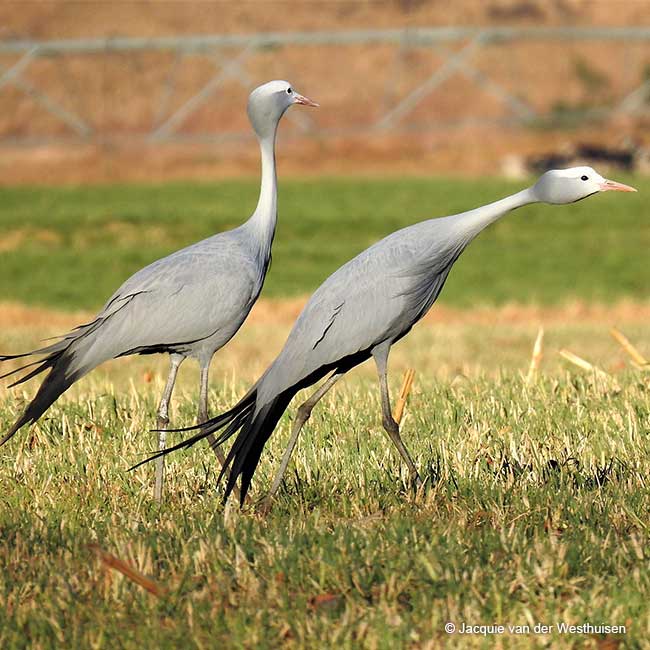
The Blue Crane, South Africa’ s national bird, has unfortunately been uplisted to Vulnerable due to population declines in the Western Cape and potentially in the Karoo.

The current population is estimated at approximately 30,000 individuals, reflecting a 39% decline since 2010. As this species is endemic to South Africa, its global survival depends entirely on conservation efforts within the country.

There is also evidence that the Blue Crane’ s range is shifting northwards from the Western Cape and westwards in the Karoo, highlighting the need to better understand how this species is adapting to changing landscapes.

The Crane Census will provide critical insights into current distribution patterns and habitat use.

Mapping crane range shifts in South Africa

Collaborative crane conservation research partnerships
Science Snippets: Can farming actually save threatened species?

Science Snippets: Can farming actually save threatened species?

Science Snippets: Can farming actually save threatened species?

Christie Craig, the ICF/EWT African Crane Conservation Programme

As human development and global change accelerate, natural ecosystems are under immense and ever-growing pressure. In some cases, ecosystems are altered to such an extent that they can be considered novel. Intensively farmed areas are an example, and these novel ecosystems affect biodiversity. As conservation biologists, we anticipate this would spell disaster for wildlife, particularly threatened species, but this isn’ t always true.

We have seen this in the case of South Africa’ s National Bird, the Blue Crane (Anthropoides paradiseus). In the 1990s, alarms were raised as this species was declining rapidly in their natural range, the eastern grasslands and the Karoo, due to grasslands being degraded and transformed for agriculture and forestry and other threats such as poisoning and powerline collisions. Interestingly, however, on the other side of the country, in the Western Cape wheatlands, Blue Cranes responded to agricultural transformation in a remarkably different way. In the early 1900s, when people began clearing fynbos (generally unsuitable habitat for Blue Cranes), Blue Cranes started to move into the Western Cape. Since then, the population has boomed in this area. Today, 50% of all Blue Cranes in the world are found in this novel ecosystem.

Conservationists were concerned because it is challenging to conserve wildlife in highly transformed landscapes like this. We have seen Blue Crane numbers decline rapidly once before, and we were concerned that this could happen again if something shifted in the Western Cape wheatlands. Intensively farmed landscapes are dynamic and influenced by social factors such as farmers’ decisions, politics, economics, and climate change. In modern conservation, many are moving away from crisis management and taking a ‘fighting fires’ approach by being more proactive and foreseeing risks to prevent species declines before they happen and to maintain conservation success. With this in mind, the African Crane Conservation Programme set up a PhD project to investigate the Blue Crane’ s conservation status, specifically focusing on understanding threats in the Western Cape wheatlands.

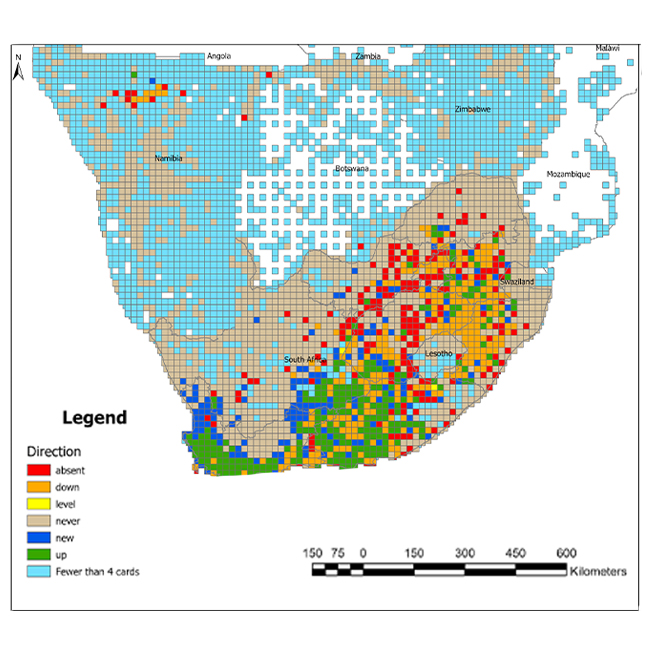
PhD candidate & Western Cape Field Officer Christie Craig has spent the last four years conducting this research and is in the process of wrapping up her thesis. Bringing all these data together, we now have a clearer picture of the state of the Blue Crane population. Over the last 30 years, we have seen an overall recovery in Blue Crane numbers, with the current national estimate obtained from aerial surveys at 44,500 Blue Cranes, which is 44% higher than the last estimate in 2002. This recovery was largely due to increases in the Western Cape wheatlands in the 1990s and early 2000s, as shown by citizen science data, i.e. Coordinated Avifaunal Roadcounts. Aerial surveys have also shown increased numbers in KZN, thanks to continued conservation action. However, the Blue Crane numbers in the grasslands are still a small remnant of what they used to be. Looking at the South African Bird Atlas Project data, we see changes in Blue Crane reporting rates, which tell us how many cranes there are. These data show that several areas of the eastern grasslands no longer have cranes, compared to the 1980s (in red, Figure 1). We hope Blue Crane numbers will recover to their full potential in the grasslands with continued conservation.

The Blue Crane’ s adaptation to wheat and pasture agriculture in the Western Cape has been their saving grace and aided their recovery. However, we have some concerns that this population is no longer thriving. Analysis of citizen science data shows that the population trend changed from positive to negative in 2010, and since then, Blue Crane counts have declined by 22% in the Overberg. If this decline is sustained, we could see the national population decline by an estimated 53% over the next 37 years. We do not know whether these declines will continue at this stage, and we are monitoring the population carefully. We cannot pinpoint a single reason for this decline, but we know from research that Western Cape breeding success is lower than it used to be and lower than the Blue Cranes in the Karoo and grasslands. In the Karoo and grasslands, EWT field workers have documented an average fledgling rate of 1.01 chicks/pair (95% confidence intervals = 0.82-1.24) in the grasslands and 1.02 chicks/pair (95% CI = 0.76-1.35) in the Karoo. Western Cape Blue Cranes only fledge an average of 0.64 (95% CI 0.42-0.95) in the Swartland and 0.81 fledglings/pair (95% CI 0.57-1.12) in the Overberg. The agricultural landscape can be challenging for breeding Blue Cranes as they attempt to breed in the dry season, when wheat is being harvested, and there is a lot of disturbance in fields. Other threats to Blue Cranes, once they fledge, include powerline collisions and poisoning.

Map showing Blue Crane reporting rates in SABAP1 vs SABAP2

Figure: Comparison of Blue Crane reporting rates in SABAP1 vs SABAP2, indicating Quarter Degree Grid Cells (QDGCs) where cranes have never been recorded (never), where they were recorded in SABAP1 but weren’ t in SABAP2 (absent) and vice versa (new), and where they were recorded in both projects, the direction of reporting rates from SABAP1 to SABAP2 (down, level or up). QDGCs with fewer than four cards in either project are indicated in blue.

Now that we have data on the population trends and threats, we will feed this directly into conservation action. The first step is to develop a conservation plan. We will host a workshop in the coming months, bringing together all the stakeholders and experts to develop a conservation planning document and implementation strategy.

This work is kindly sponsored by Neuwied Zoo, Jacksonville Zoo, Safari West, Nashville Zoo, and the Leiden Conservation Foundation. The PhD research was funded by the Leiden Conservation Foundation, Eskom & the Hall-Johnson Fellowship.