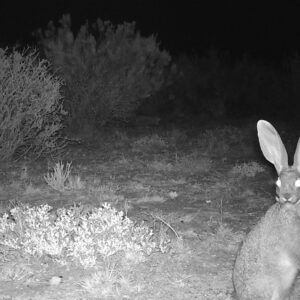
PUSHING THE BOUNDARIES FOR RIVERINE RABBITS IN THE ANYSBERG
Bonnie Schumann, the EWT’ s Drylands Conservation Programme, bonnies@ewt.org.za
The ancient landscapes of the Karoo are home to one of South Africa’ s most elusive and Critically Endangered species, the Riverine Rabbit. Riverine Rabbits occur in three known populations in three separate regions of the Karoo. Originally thought to only occur in the Nama Karoo, where they were first discovered in 1901, rabbits were later discovered near Touwsriver in the Succulent Karoo in 2003. This discovery completely upended the applecart on what we knew about the distribution and behaviour of this species. However, at least one other surprise was awaiting us when a third population was discovered west of the Baviaanskloof in 2018.

In the 1990s, landowners and conservationists joined forces to create Riverine Rabbit conservancies in the Loxton-Fraserburgh-Beaufort West area of the Nama Karoo to conserve the species. These conservancies still exist today. Even though many of these landowners rarely, or in some cases, have never seen a Riverine Rabbit, they are passionate about conserving them on their properties. While rabbits occur in three different regions of the Karoo, their threats are the same in all three landscapes. The most severe threats are habitat loss and damage to the remaining habitat. The floodplains of the seasonal rivers in the Karoo consist of deep alluvial soil areas that make for fertile agricultural soil in an otherwise arid landscape. These areas are largely transformed into ploughed lands, which in many cases now lie fallow and abandoned. The changing economic situations and erratic rainfall make it risky to depend on rain-fed cropping and flood irrigation. In recent decades, it has not been worthwhile to grow rain-fed crops in many places across the drylands.
 In the past, the riparian areas, often comprising floodplains a few kilometres wide, were densely vegetated and would have provided a unique habitat to a range of species, including the Riverine Rabbit. The loss of over 60% of the riparian vegetation was devastating for the Nama Karoo Riverine Rabbit population. Outside of the riparian zone, the vegetation does not provide enough cover for a species that relies on dense vegetation to avoid detection and capture by predators. Rabbits have disappeared from areas where the vegetation is overgrazed and “opened up” by livestock. They are an indicator species for ecosystem health, and If the riparian vegetation is managed sustainably, rabbits will persist. If not, they will continue to quietly vanish.
Following the initial discovery of rabbits in the Succulent Karoo, surveys for rabbits took place in the riparian areas, based on the assumption that the “southern” rabbits use the landscape similarly to their Nama Karoo counterparts, which are riparian habitat specialists. Here is where it became interesting. What is now clear is that rabbits in the Succulent Karoo can range more widely across the landscape, occurring outside of riparian areas where the vegetation on the gently sloping hills is often quite dense. They occur outside the riparian zones, and their range also extends into a third Biome, the Fynbos Biome, where they primarily favour the Renosterveld vegetation. The fact that the rabbits can persist in vegetation units outside the riparian zones in the Succulent Karoo is very fortunate, given that much of their riparian habitat has been lost to agriculture. This means that the gently sloping areas that are unsuitable for ploughing and are densely vegetated have provided critical refuges for rabbits. It is probably safe to speculate that Riverine Rabbits were once widely distributed along the valleys and hills of the Little Karoo. However, the extensive loss of habitat across this region has resulted in them remaining only in pockets of suitable intact vegetation. Conservationists are researching the genetics of the region’ s rabbit populations – how closely they are related to each other and their overall genetic health – to understand how viable the populations are and if any connectivity (gene-flow) between the three populations still exists.
The spectacular Anysberg Nature Reserve was officially declared in 1990 to formally protect the incredible but highly threatened biodiversity of the Succulent Karoo, an internationally recognised biodiversity “hotspot”. Riverine Rabbits were recorded in the reserve for the first time in 2013. This was the best news of the century for rabbit conservation because the discovery meant that the reserve was the first formally protected area to boast a Riverine Rabbit population. What is doubly exciting is that landowners bordering the reserve had a vision for conservation going back 25 years. Several individuals bought properties in this area to conserve the land and wildlife. Livestock was removed, and the land has been resting and recovering ever since. In 2018, one of the landowners approached the Endangered Wildlife Trust to assist him in taking his conservation efforts to the next level by declaring the property a contractual Nature Reserve. As a result, the Endangered Wildlife Trust, CapeNature (the designated authority with statutory responsibility for biodiversity conservation in the Western Cape) and six landowners are collaborating to declare a cluster of properties as nature reserves. These contractual reserves will be formally protected and attain the same status as the Provincial Reserves, effectively expanding protected areas at a national level. This essentially means that the Anysberg Nature Reserve, also a World Heritage Site, will be buffered by an additional 20,000 hectares of protected landscapes. Several additional vegetation units, each supporting unique and, in many cases, endemic plant and animal species, not yet included in the Anysberg Nature Reserve, will now also be formally protected.This initiative is testimony to what can be achieved when stakeholders combine forces to achieve a shared vision. Many species facing severe persecution outside protected areas, including Leopard, Brown Hyaena and Honey Badger, will now be able to safely roam over an increasingly vast area. And, of course, as the largest formally protected area cluster for Riverine Rabbits, it now represents the single most important stronghold for Riverine Rabbits in South Africa. In this case, size is critical, as only a small portion of the entire area will meet the habitat requirements for rabbits, so the bigger the area, the better.
 Ecotourism, including adventure tourism and, in some cases, limited agricultural activities, provide a diversified income for the landowners around the Anysberg Nature Reserve. This is an extremely marginal area for extensive livestock production, and the reality is that the veld has been utilised to, and in some cases beyond, its limits and can no longer support herds of goats and sheep. Developing a “green” conservation-based economy can breathe new life into this region where poverty and unemployment are rife. Ecotourism provides jobs, supports livelihoods, and can help fund the restoration work that needs to be done in the degraded areas. The Anysberg is only approximately 260 kilometres from Cape Town, making it easily accessible as a weekend getaway. It is also easily accessible to international tourists looking for some peace and quiet in one of the most beautiful and safe regions of South Africa.
There are few undiscovered natural gems left out there. The Anysberg area is truly one of the most exciting and largely undiscovered gems in South Africa. The shared vision for this area is to develop an economy based on what the region has to offer in terms of unspoiled landscapes, wide-open skies, and incredible scenic beauty while conserving the unrivalled unique biodiversity of the Succulent Karoo. The project’ s next phase is supported by IUCN Save Our Species and co-funded by the European Union.
For more information, visit:
www.ewt.org.za
https://www.capenature.co.za/reserves/anysberg-nature-reserve
www.karooforever.co.za
LATEST STORIES
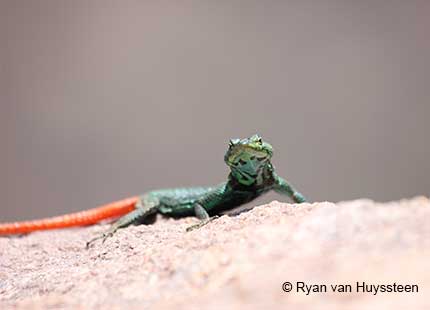
Reptile Awareness Day Shines Spotlight on Western Cape’s Scaled Biodiversity
This Reptile Awareness Day, we celebrate the remarkable diversity found at Lettas Kraal Private Nature Reserve in the Anysberg region. The Western Cape boasts 155 reptile species, with 22 found nowhere else on Earth. Situated in the transitional zone between mountain fynbos and Klein Karoo veld, Lettas Kraal’s 7,000 hectares provide critical habitat for 54 reptile species – 31 of which were recorded during a 2020 survey by EWT’s Drylands Conservation Programme.
Notable Species at Lettas Kraal
The reserve protects both common and threatened reptiles including:
- Endangered Karoo Dwarf Tortoise (Chersobius boulengeri) – IUCN Red Listed
- Karoo Sand Snake (Psammophis notostictus)
- Western Sandveld Lizard (Nucras tessellata)
- Bibron’s Thick-Toed Gecko (Chondrodactylus bibronii)
- Karoo Dwarf Chameleon (Bradypodion gutturale)
Reptile Awareness Day Initiatives
Our educational event for Anysberg landowners and farmworkers covered:
Identification of local reptile families
- Venomous snake awareness and bite first aid
- Myth-busting about snake behaviour
- Dangerous arachnid recognition (spiders/scorpions)
- Hands-on encounters with common species
Why This Matters
As former EWT Field Officer Jean-Pierre Le Roux notes, Lettas Kraal’s size makes it invaluable for reptile conservation. The reserve:
- Protects vulnerable endemic species
- Provides corridors between habitats
- Offers research opportunities
- Educates local communities
This Reptile Awareness Day, we encourage everyone to appreciate these often-misunderstood creatures that play vital roles in our ecosystems.
Learn more:
Lettas Kraal Nature Reserve
EWT Drylands Programme
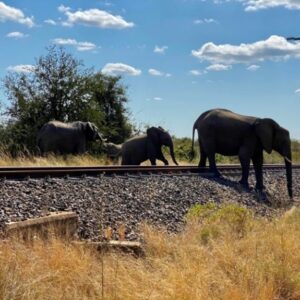
HOW DID THE ELEPHANT CROSS THE RAILWAY LINE?
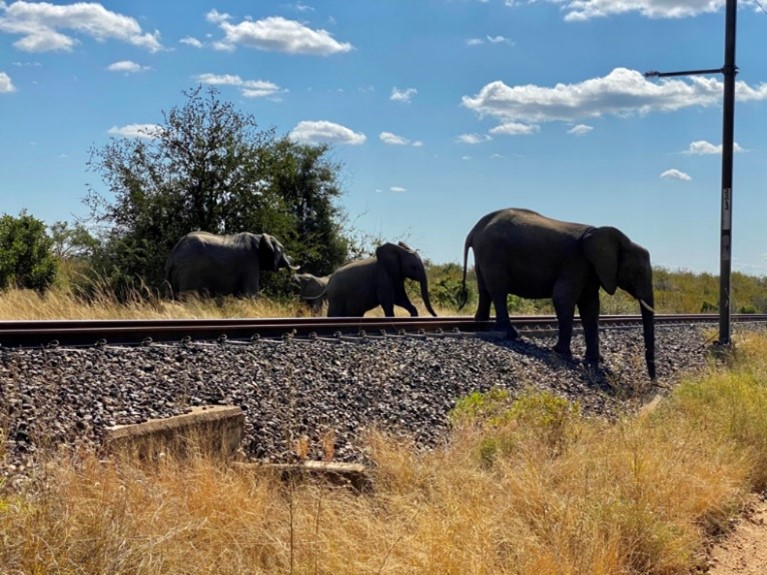
Hannah de Villiers By walking across, of course! Below you can see a breeding herd of elephant in the Balule Nature Reserve (part of the Greater Kruger) casually walking over a railway line.
Transport infrastructure plays a pivotal role in economic and social development through creating improved access to resources and associated livelihood provided. Railways are a critical component of sustainable transportation, having many environmental and economic advantages over other forms of transport, and are therefore seeing massive expansion globally. In Africa, more than 30 massive development corridors, including rail infrastructure, are planned or progressing, with the rail footprint on the continent expected to increase by 85% in the coming years. However, these corridors will pass through hundreds of protected areas containing some of Earth’ s most diverse and sensitive ecosystems.
As conservationists, we are concerned about two key ecological impacts of railways: the barrier effects and resultant habitat fragmentation it may cause for local wildlife populations and the mortality it might cause through wildlife-train collisions. For some animals, like the elephants above, the railway does not create a barrier in the landscape, and they are often seen simply walking over it. But this means they are in danger of collisions with trains – which, unlike cars, cannot quickly slow down or swerve to avoid a collision.
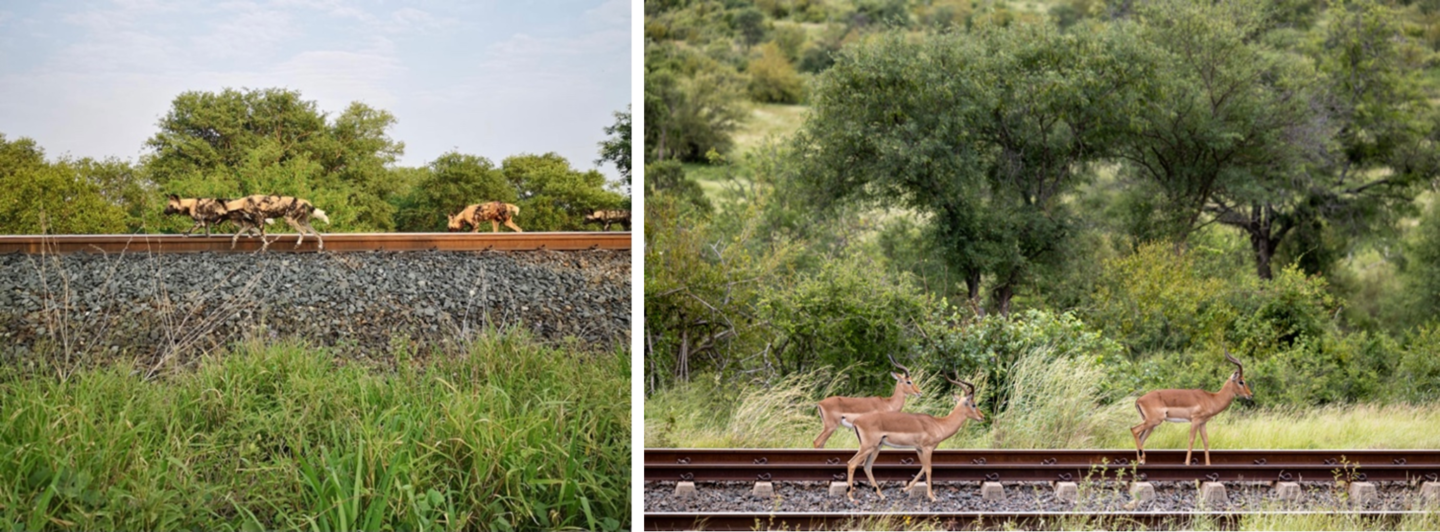
But what if animals could find a safe passage across the railway without the risk of collisions, which would increase the permeability of the rail corridor and improve habitat connectivity? Wildlife crossing structures provide just that, and luckily culverts or viaducts are a common design feature of all railways, typically built for drainage and topographical purposes. These pre-existing underpass structures can easily be modified to improve their use by wildlife, which is regarded as the most economical and feasible form of mitigation for wildlife mortality and barrier effects. The economic advantages of this approach do not stop there: train collisions with large mammals can be incredibly expensive, invariably damaging or derailing trains and often resulting in large-scale service disruptions.
Hannah is researching the use of railway underpasses and drainage culverts (such as the one seen on the left in the photo of elephants crossing the railway) by large mammals in the Balule Nature Reserve. She is putting up camera traps at the underpass entrances to understand which species use them (or don’ t use them) and see how the structural dimensions, the nature of the habitat close to the structure, the surrounding landscape and mammal characteristics affect usage.
The findings of this study will help inform the design of underpasses along new railways in the African context and aid reserve management in decisions regarding economically feasible modifications to culverts along existing railway lines that would make them more attractive for large mammal use.
This project is supervised by Gabi Teren (from the EWT’ s National Business and Biodiversity Network) and Francesca Parrini (University of the Witwatersrand), and advised by Wendy Collinson (EWT Wildlife and Transport Programme), Paul Allin (Transfrontier Africa, Balule), and Dr Manisha Bhardwaj (Swedish University of Agricultural Sciences).
PULLING THE RABBIT OUT OF THE HAT ON ANYSBERG NATURE RESERVE
Marienne de Villiers, CapeNature, Faunal Ecologist, mdevilliers@capenature.co.za
While the habitat requirements of Riverine Rabbits in the Nama Karoo are pretty well understood, the same can’ t be said for the Little Karoo. Understanding what constitutes suitable Riverine Rabbit habitat, or what has been coined “Rabitat” by the Endangered Wildlife Trust’ s bunny expert Bonnie Schumann, is the first step towards conserving this Critically Endangered species.
Since they were first discovered on CapeNature’ s Anysberg Nature Reserve in 2013, there have only been a handful of sightings of these rare bunnies. These do include some spectacular observations, however. The 2013 record was made when a Riverine Rabbit was captured by hand by CapeNature’ s Corné Claassen and Marius Brand. The youngster was released unharmed after providing a valuable genetic sample. In 2019, Ishmael Wambi, a Nature Conservator at Anysberg, got some amazing video footage of a Riverine Rabbit that was startled in the headlights of his vehicle; you can view the video on this link: https://vimeo.com/328121696. And earlier this year, surprised Anysberg Field Rangers flushed two startled rabbits in the middle of the day while carrying out a game count.
While it is good to know that Riverine Rabbits are persisting in the reserve nine years after their discovery, there are still vital questions that need to be answered to ensure the protection of the species. Thanks to land purchases by WWF-SA, Anysberg is a relatively large reserve at just over 80,000 ha. But how much of this area constitutes rabitat? By working in partnership with EWT’ s Drylands Conservation Programme, CapeNature aims to improve our understanding of Riverine Rabbit habitat requirements in the greater Anysberg area and to ultimately use this information to predict population size on the Anysberg Nature Reserve.
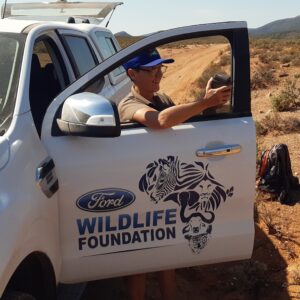
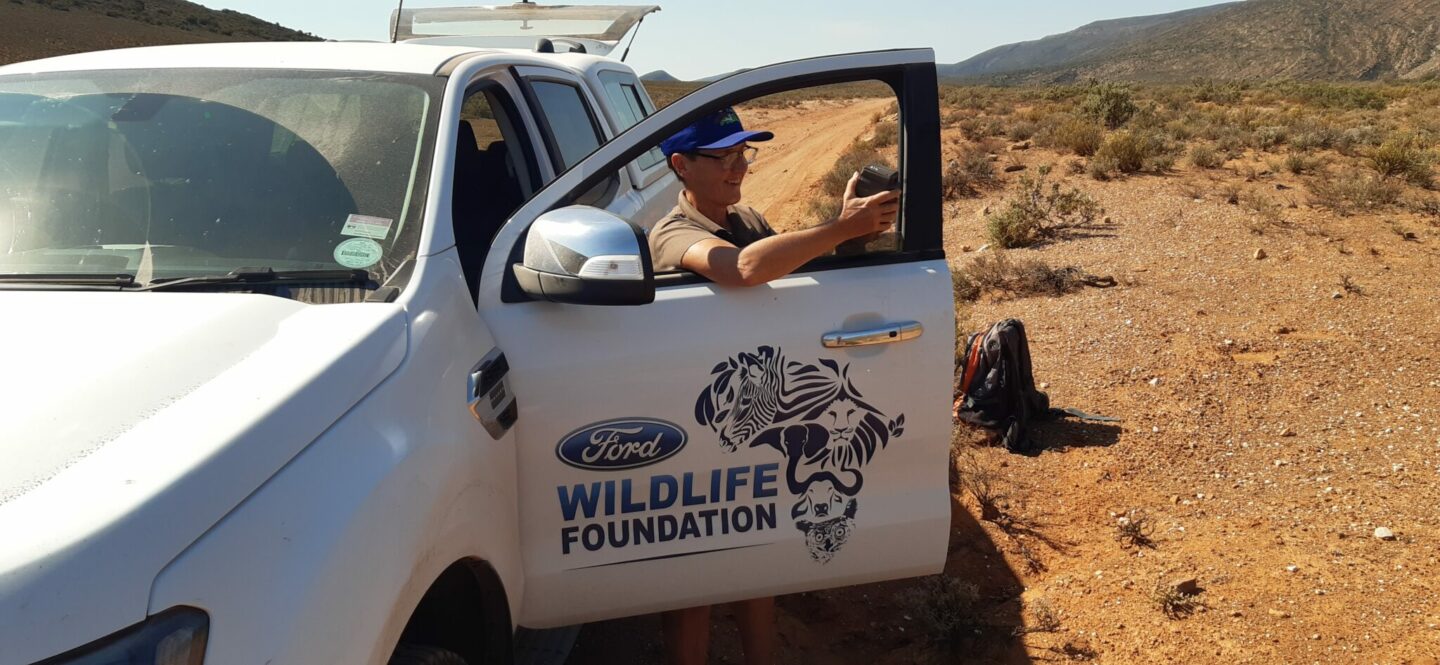
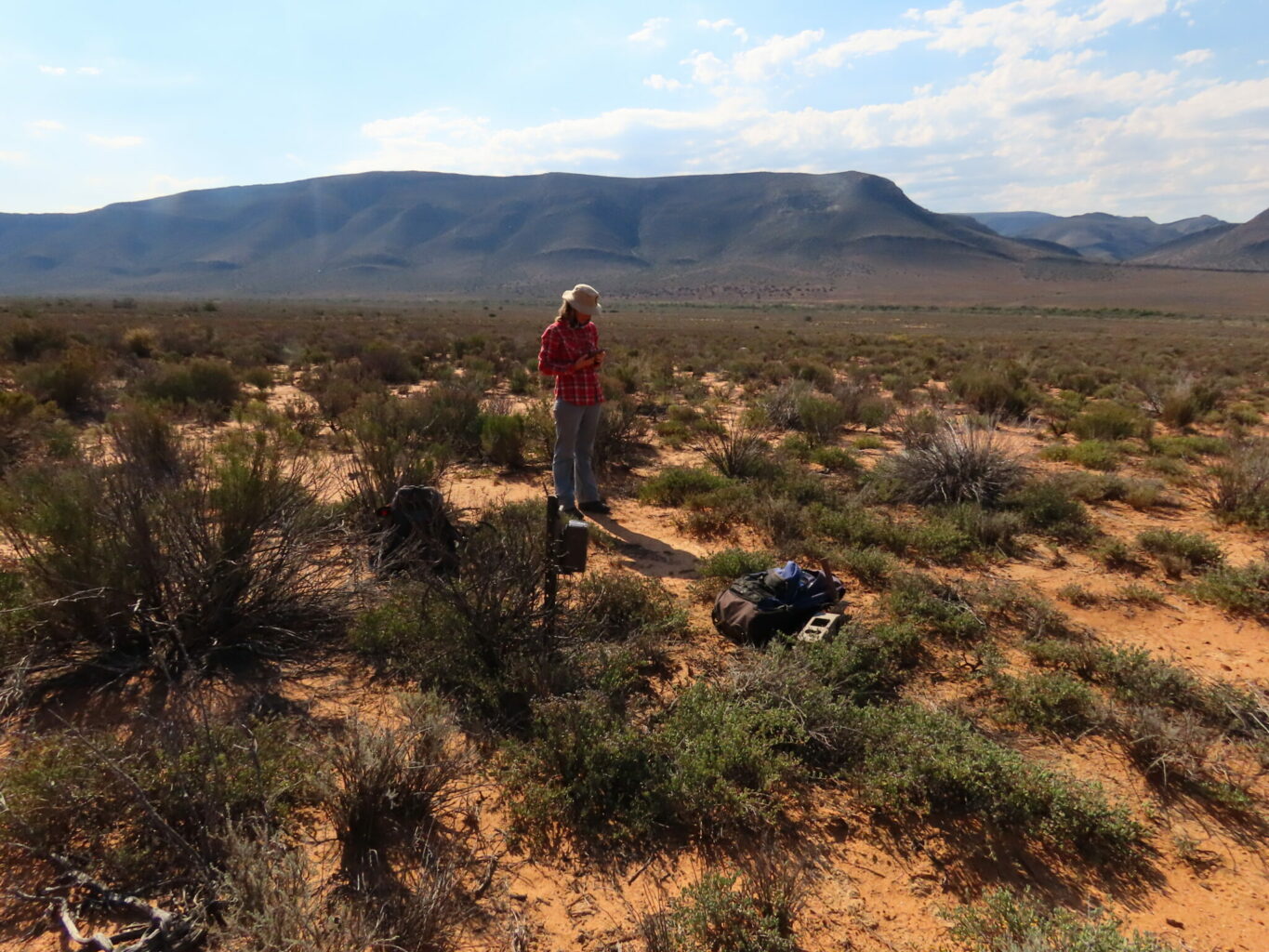
As a first step towards addressing this question, Bonnie Schuman from the EWT spent a day on Anysberg, sharing her considerable experience and expertise on the species and its requirements with CapeNature Faunal Ecologist Marienne de Villiers. With her bunny radar turned on and finely tuned, Bonnie also advised on the placement of camera traps to test for the presence of bunnies in an area on Anysberg that has never been searched for rabbits before, but where they might well occur. To read more about this excursion here) The long-term plan is to map the reserve according to potential rabitat, looking at various criteria, including soil type, slope, vegetation structure, and density. Then we will test these areas for rabbit presence using camera traps. But for now, it’ s a waiting game. The cameras will stay out in the field for at least six weeks; only when the memory cards are downloaded will we know if the rabbit is in the hat, so to speak.
For more information on the Anysberg Nature Reserve:
https://www.capenature.co.za/reserves/anysberg-nature-reserve/
For more information on the Endangered Wildlife Trust:
https://ewt.org/


 In the past, the riparian areas, often comprising floodplains a few kilometres wide, were densely vegetated and would have provided a unique habitat to a range of species, including the Riverine Rabbit. The loss of over 60% of the riparian vegetation was devastating for the Nama Karoo Riverine Rabbit population. Outside of the riparian zone, the vegetation does not provide enough cover for a species that relies on dense vegetation to avoid detection and capture by predators. Rabbits have disappeared from areas where the vegetation is overgrazed and “opened up” by livestock. They are an indicator species for ecosystem health, and If the riparian vegetation is managed sustainably, rabbits will persist. If not, they will continue to quietly vanish.
 Ecotourism, including adventure tourism and, in some cases, limited agricultural activities, provide a diversified income for the landowners around the Anysberg Nature Reserve. This is an extremely marginal area for extensive livestock production, and the reality is that the veld has been utilised to, and in some cases beyond, its limits and can no longer support herds of goats and sheep. Developing a “green” conservation-based economy can breathe new life into this region where poverty and unemployment are rife. Ecotourism provides jobs, supports livelihoods, and can help fund the restoration work that needs to be done in the degraded areas. The Anysberg is only approximately 260 kilometres from Cape Town, making it easily accessible as a weekend getaway. It is also easily accessible to international tourists looking for some peace and quiet in one of the most beautiful and safe regions of South Africa.