Start17 November 2026
The EWT expands its conservation footprint despite global and climatic challenges
The Endangered Wildlife Trust (EWT) has ensured that more than a million hectares of land has been placed under improved conservation management, alongside the creation of new nature reserves that now protect an additional 15,000 ha in South Africa’s Drylands. And all of this in just one year.
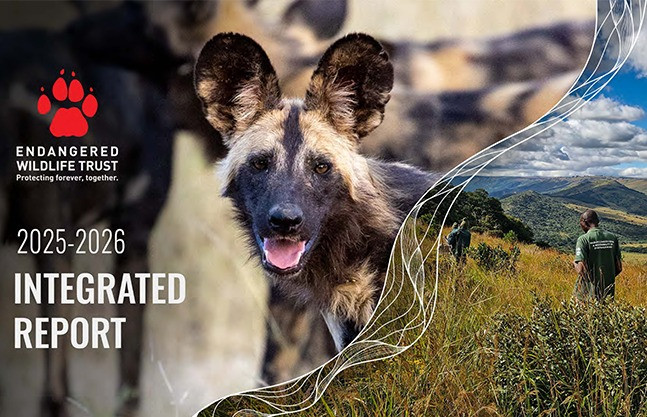
These are but two of the successes detailed in the EWT’s 2025/26 Integrated Report. The highlights in this year’s report highlight the work done by a growing team to not only conserve and restore habitats, but grow the conservation estate across southern and East Africa ensuring that both wildlife and people thrive together. At the heart of our work is a simple but powerful objective: ensuring the survival of threatened species and the ecosystems upon which they depend.
This year’s report is proof of our ability to turn scientific evidence into action through the design and implementation of recovery and restoration plans for damaged habitats, the rediscovery and monitoring of elusive and under-reported species, the relocation of Endangered species to expand their ranges through new viable populations, and the reduction of poisoning and snaring threats to all wildlife. Additionally, we supported our partners, protect water sources and work alongside communities to build solutions that last.
In the year under review, we translated the EWT’s 2050 Future Fit Strategy into visible, measurable impact in nine Strategic Conservation Landscapes across southern and East Africa coordinating action across these areas to secure the future of multiple species by protecting their habitats, reducing survival threats and working with the people that share their landscapes.
We targeted a further 35,000 ha of land for future protected area expansion in the Savannah Strategic Conservation Landscape and Northern Drakensberg, while more than 8,000 ha has been earmarked for conservation protection in the Eastern Cape.
Moreover, 50,000ha of land was added to the Vulture Safe Zones in the Karoo and Kalahari, and biodiversity assessments completed across 43,000 ha in the Waterberg expansion initiative.
We believe that healthy ecosystems underpin economic prosperity. Agriculture, tourism, water security, food production and countless livelihoods depend on functioning natural systems. Equally, conservation cannot succeed if communities living with and alongside wildlife do not experience tangible benefits. Our approach recognises this interconnectedness. By working with communities, businesses and government, we develop solutions that protect biodiversity while creating economic opportunity.
Our groundbreaking Eye in the Sky system utilised the information provided though tracked vultures to provide early warnings of several poisoning and snaring events, where rapid responses helped to prevent casualties at least two sites, uncovered five poaching camps and supported the removal of 158 snares.
Our carnivore specialists coordinated the strategic movement of 43 Cheetahs across 21 reserves, supported the return of Cheetahs to uMkhuze Game Reserve and helped recover approximately 40,000 ha of vital Cheetah range. We also supported African Wild Dog reintroductions in Zimbabwe, Malawi and South Africa, while a newly established Threat Reduction Ranger Team responded to human-wildlife conflict incidents in real time and prevented retaliatory action and livestock losses to the benefit of both communities and wild predators.
In the Drakensberg Grasslands, our teams recorded 84 Critically Endangered Wattled Crane nests, monitoring 75 of them by drone, and ringed eight chicks: the highest number in almost a decade. They cleared and began rehabilitating 620 ha of critical grassland, wetland and riparian habitat in the headwaters of the Vaal River, while creating and developing skills for 32 previously unemployed local people. Working with community partners, we protected three springs and installed water infrastructure for 140 households, benefiting 1,162 people. The EWT/ International Crane Foundation’s pioneering grassland carbon project covering 90,000 ha, issued credits representing 805,971 tonnes of carbon dioxide sequestered and generated almost US$1 million for participating landowners and project implementers. Our IKI-supported Restoring Landscapes in South Africa (ReLISA) team assessed an additional 585,000 ha for future soil carbon opportunities.
Our staff produced 343 research outputs that strengthened the evidence base for conservation decision-making across the region. Milestones included the 2025 revision of the Mammal Red List of South Africa, Lesotho, and Eswatini, for which all 332 species assessments were finalised and uploaded to a dedicated online platform. Two major spatial planning tools were developed — the RSA Landscape Planning Tool, developed under the 30-by-30 Renewables Project – and the Land-Use Decision Support Tool for Species of Conservation Concern (LUDS-SCC) in collaboration with SANBI.
END