Start4 July 2023
Innovative mobile emergency response unit saves poisoned vultures
Eight vultures, including six White-backed Vultures, one Lappet-faced Vulture, and one Hooded Vulture that survived a mass poisoning incident in June, were released back into the wild on 1 July 2023 after being successfully rehabilitated. The Great Limpopo Transfrontier Conservation Area (GLTCA), which includes the Kruger National Park and surrounding reserves, forms a vulture-rich landscape in which these birds play a critical role. It is also a high-risk area for wildlife poisoning, with at least 796 vultures across five threatened species killed in the area since January 2019. In the GLTFCA, vultures are often poisoned and harvested for their body parts for use in traditional medicine. They also regularly fall as the unintended victims for poisons left out for other wildlife such as lions, hyaenas and leopards, which are also targeted and slaughtered for their body parts, or because they threaten local livestock.
At 14:50, on Youth Day (16 June), the Endangered Wildlife Trust (EWT) Birds of Prey Programme Lowveld team, John Davies and Dr Lindy Thomson, responded to a call regarding a wildlife poisoning incident on a reserve in the Greater Kruger area. They were on the road in ten minutes and arrived just before sunset at a dismal scene with one dead and two live White-backed Vultures in grave condition. The team loaded the two surviving birds into crates in the EWT’s custom-made Vulture Ambulance and rushed them to Moholoholo Wildlife Rehabilitation Centre near Hoedspruit – arriving at 11 pm. Determined that there were more lives to save, John and Lindy returned with the ambulance at 4 am the following day and, joined by SANParks rangers, Honorary Rangers, and Dr Joel Alves and Isabella Grünberger from WildScapes Veterinary and Conservation Services, they scoured the area for six hours, discovering and bringing more survivors back to the ambulance for treatment as they were found.
The main poisoning scene was deep in the bush, and after the vet, Dr Joel Alves and the EWT’s John Davies treated each bird on site, a team member then carried the birds 3 km to where the Vulture Ambulance was parked. Another six vultures (one Hooded, one Lappet-faced, and four White-backed vultures) were critical but still alive, while 45 vultures, a Bateleur Eagle, a lion, and three lion cubs did not survive the poisoning. The surviving birds were safely delivered to the Moholoholo Wildlife Rehabilitation Centre, where they were treated successfully by Dr Jess Briner and the Moholoholo clinic team and allowed to recover for two weeks before they could be returned to the wild. Before their release on 1 July 2023, the birds were fitted with leg rings and solar-powered GPS-tracking units that will allow the EWT to monitor their movements and respond to any indication of unusual behaviours, such as immobility, for longer than normal periods.
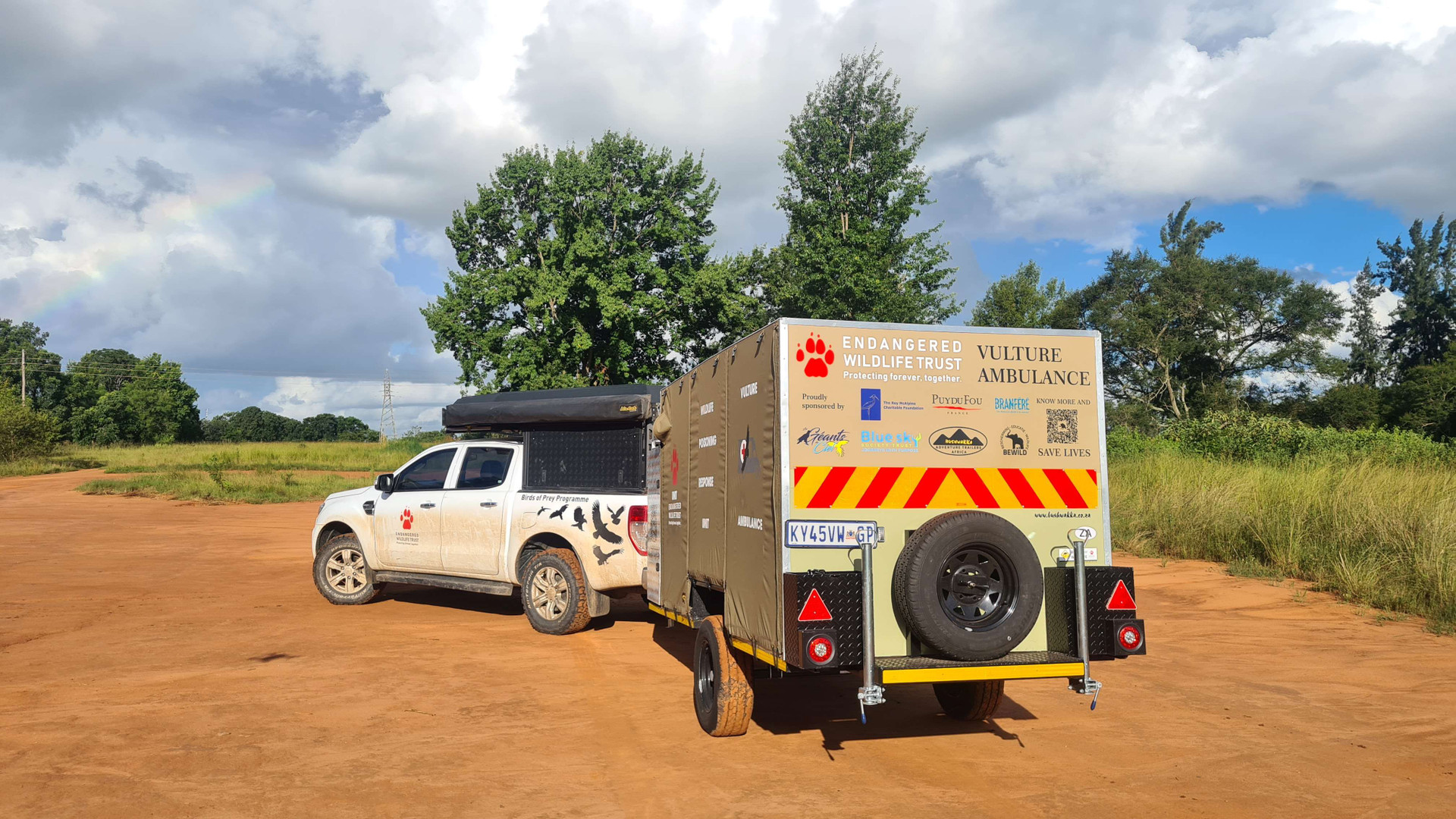
The EWT Birds of Prey Programme Lowveld team always carry a poisoning response kit in their backpacks, which allows them to perform basic treatments on-site, to give poisoned vultures a fighting chance until a vet can attend to them. With the increase in wildlife poisoning throughout the GLTCA in recent years, the EWT and its donors have developed an essential, custom-made tool to support our efforts to curb the impact of disastrous poisoning events. The EWT’s long-awaited, specially designed Vulture Ambulance was the brainchild of the EWT’s Dr Gareth Tate and is already contributing to the successful rescue, on-site treatment, and safe transport of these wild birds whose lives hang in the balance.
Poisoning events are increasingly happening in vast and often inaccessible areas over a day’s drive from rehabilitation centres. Arriving at the scene of a poisoning incident, experienced responders must administer first aid immediately and stabilise surviving birds. The birds then need a cool, quiet place to rest during the trip to the rehabilitation centre, which can be well over eight hours’ travel from the poisoning sites. In some cases, teams must overnight in the field, where the trailer becomes even more vital – allowing them to monitor the condition of vultures closely and keep them stable. The EWT’s Vulture Ambulance can transport up to 20 birds in modular, easy-to-remove crates that can be accessed without disturbing other resting birds. The trailer includes a mobile clinic, first aid station, water, fuel, and equipment needed to rapidly and successfully rescue, stabilise, treat, and transport poisoned survivors. This has already proven to significantly increase the number of birds that survive these catastrophic events.
The EWT’s Vulture Ambulance is strategically stationed within a high-poisoning-risk area, and we hope to develop more units to service other key sites in southern Africa to help us save many more vultures. This world-first ambulance was made possible with donations made by the Roy McAlpine Charitable Foundation, Puy du Fou, Gauntlett Conservation Trust, Geants du Ciel, Bushwakka Adventure Trailers, Blue Sky Society Trust, BEWILD, Branfere, and Alu-Cab. To contribute to the development of additional ambulances, please click here.
END